
One of the most important features of Josef Q is what we call human-in-the-loop training.
This involves creators reviewing a record of the questions users have asked and how the tool has responded.
If a creator notices that a particular generated answer was incorrect or can be improved in some way, they can jump in and edit it for next time by adding it to their training set.
How to add training responses to your training set
Creators can add responses to their training set by:
- Going directly to the tool's Training tab, or by
- First, viewing the tool, asking it a question, then clicking Review in Training to open the training response pop-up window.
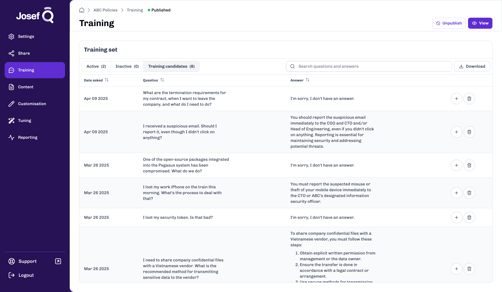
Via Training tab
To review your tool's responses via the Training tab:
- Log in to Josef Q and select the relevant tool via the Dashboard.
- Select Training in the left-hand sidebar. In the Training candidates tab, a list of questions answers will be available for you to review.
- Select the (+) button review, edit and add a specific question to your training set.
- Click the 'Add to training' button to add the candidate to your training set.
- Once added to your training set, the training response will be used by your tool to improve future answers.
Via the tool Ask page
To add/edit your Q&A's responses via the tool's user interface (Ask page):
- First, view and interact with your tool,
- Ask a question,
- Then, click Review in Training at the bottom of the tool’s response.
- Next, the Training response window will pop up.
- Review, edit the answer, and/or update the sources to add an ideal answer to your training set.
Managing training responses
There are a few things creators can do to manage responses here. They include:
- Moderating answers (i.e. editing the text that comprises an answer),
- Determining whether or not the tool should respond with ‘no answer,’ and
- Selecting what source material forms the basis of the tool's answer.
Here's how to do all three.
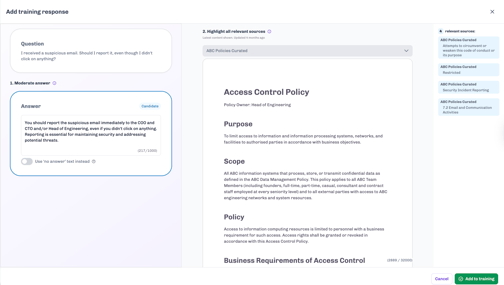
1. Moderate answer
In the blue Answer field, creators can moderate (i.e. edit the text of) the answer generated in response to a particular question.
2. Respond with ‘no answer’
Creators can also toggle off/on the Use ‘no answer’ text instead for cases where they’d rather the tool responded something like, “I’m sorry, I don’t have an answer.’
3. Highlight all relevant sources
On the right, creators can also review an answers’ relevant sources. These are extracted from the tool's uploaded document (aka its knowledge base).
To select and deselect a relevant source, highlight the text and click the highlighter button.
4. Approve
Once you have finished moderating the response, click Add to training and you’re done!
Next time a user asks this or similar question, the tool’s will use the training response you've added to formulate its answer.
Post-knowledge base update
Once creators have updated their knowledge base with a new document, they’ll need to review and approve their tool’s past training set answers.
This ensures your tool’s new content interacts with past answers as you’d like it to.
To learn how, visit this page and read the section “Updating your tool."